Bitcoin's Quantum Conundrum: Recovery Tool Emerges, But Satoshi's Coins Remain Vulnerable

Live market snapshot (at publish): BTC $64,556 (+0.9% 24h)
The recovery tool, developed by research outfit Project Eleven, allows users to recover their coins in the event of a quantum attack, but it does not apply to the 1.1 million coins attributed to Satoshi Nakamoto, the presumed pseudonym used by the inventor of Bitcoin. Bitcoin's quantum problem has long been a concern for the cryptocurrency community, with an estimated 34% of all bitcoin sitting in addresses vulnerable to quantum computers.
1.1 million BTC attributed to Satoshi Nakamoto remain vulnerable to quantum attacks
The recovery tool relies on the tree structure introduced by BIP-32, which was assigned in 2012. This means that users who have generated their keys using BIP-32 can utilize the recovery tool, but Satoshi's coins, which were mined in 2009 and 2010, are not eligible.
"The entire trick depends on there being a key above a user’s address to prove knowledge of, and that the tree structure arrived with BIP-32, which was assigned on February 11, 2012." — Shaurya Malwa, Ecosystems Lead - Markets, Data & Tokens, CoinDesk
The spot market has seen a 15.3% increase in volume, reaching $1.11T, while RWA perpetual volumes have reached $311B. Companies like Bullish (NYSE:BLSH) are investing in digital asset businesses and digital assets, further highlighting the growing interest.
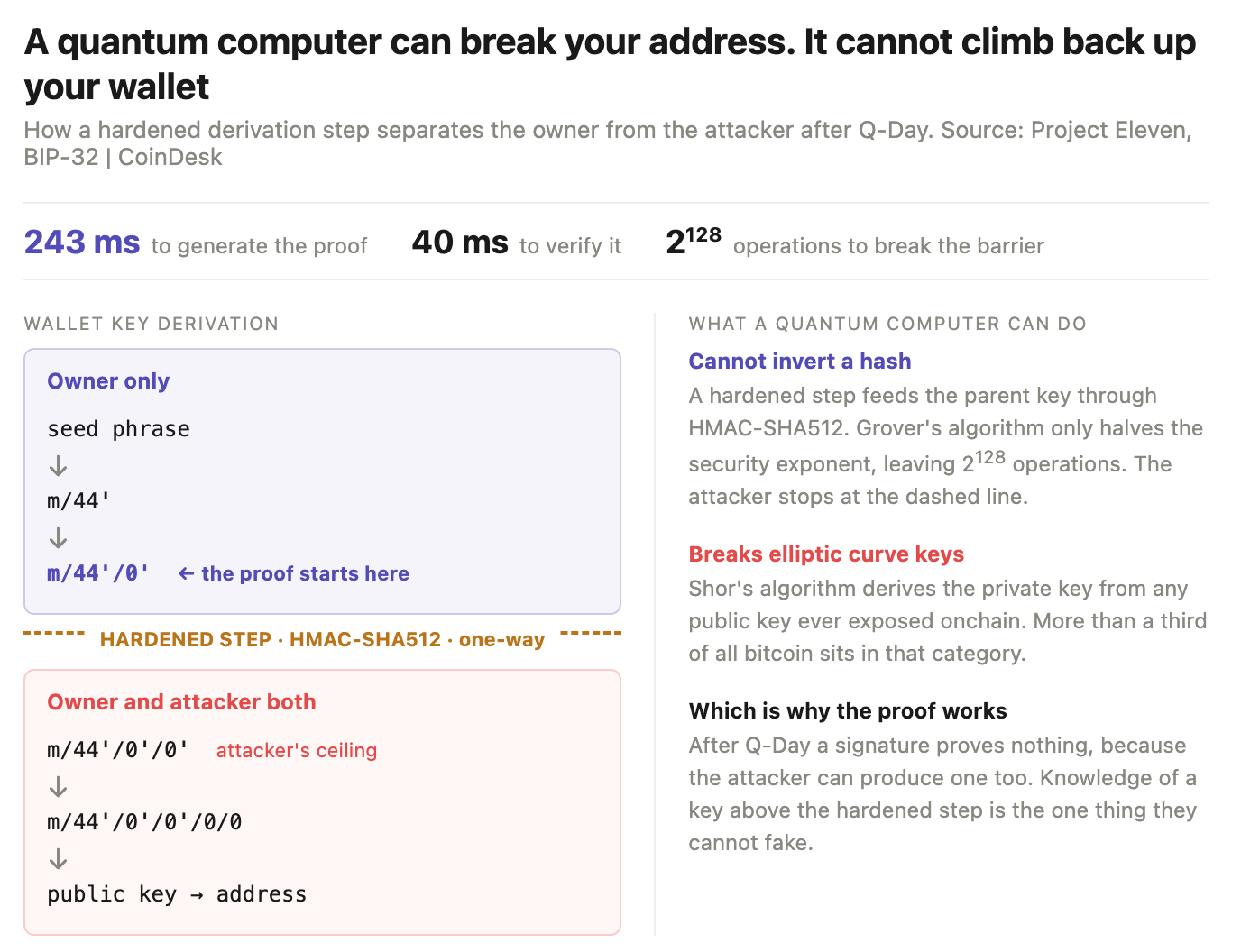
The recovery tool has shown promising results, with a generation time of 243ms and a verification time of 40ms. The tool also uses 2GB of memory and is 16 times faster than prior work. Project Eleven's prototype has a generation time of 910ms, demonstrating the potential for improvement.
Analysis: If the recovery tool gains widespread adoption, it could potentially stabilize the market by alleviating concerns about the freeze of quantum-vulnerable coins. However, the fact that Satoshi's coins remain vulnerable may still pose a risk to the market. A break below the current support level could signal a larger market downturn, while a successful implementation of the recovery tool could lead to increased investor confidence. The development of this recovery tool is a significant step forward in addressing the quantum problem in Bitcoin.
Frequently Asked Questions
- What is the quantum problem in Bitcoin?
- The quantum problem refers to the vulnerability of Bitcoin's cryptographic algorithms to quantum computer attacks.
- How many Bitcoin are attributed to Satoshi Nakamoto?
- Approximately 1.1 million BTC are attributed to Satoshi Nakamoto, the presumed pseudonym used by the inventor of Bitcoin.
- What is the significance of BIP-32 in the context of Bitcoin's quantum problem?
- BIP-32, assigned in 2012, introduced a tree structure that allows for the creation of a key above a user's address, enabling the proof of knowledge required for the recovery tool.