Institutions Look Beyond Audits for Crypto Security

Live market snapshot (at publish): BTC $64,351 (-0.3% 24h) · ETH $1,873.47 (-0.0% 24h)
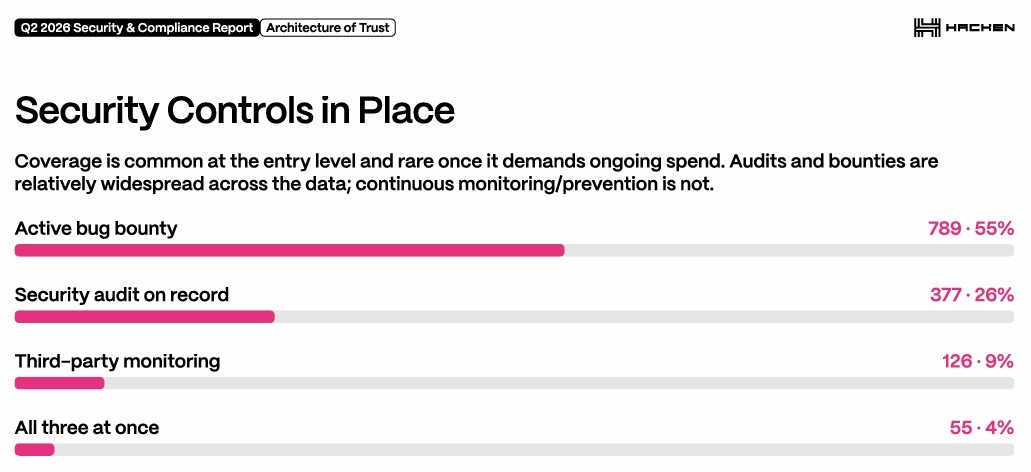
Institutional investors are reevaluating their approach to crypto security, moving beyond traditional trust signals such as smart contract audits and operating history. This shift in focus comes as investors seek to better assess the risk of crypto projects, which have been vulnerable to exploitation despite having undergone audits. The report by Hacken highlights the inadequacy of current security measures, with only 9% of tracked projects having third-party monitoring, and a mere 4% having both monitoring and security audits in place.
$764 million in stolen funds during the quarter, with 88.3% attributed to compromised keys, signers, and infrastructure. This lack of robust security measures has led to significant financial losses, underscoring the importance of operational resilience. Notably, compromised keys, signers, and infrastructure account for the majority of stolen funds.
Federico Bagiotti, group head of risk management at Abraxas Capital, notes that many crypto projects have "inadequate security relative to the capital at risk."
"inadequate security relative to the capital at risk" — Federico Bagiotti, group head of risk management at Abraxas Capital. This sentiment is echoed by others, who emphasize that institutions are now evaluating security, compliance, and governance through a more practical lens.
The shift in focus towards operational resilience may lead to increased scrutiny of crypto projects and potentially impact investor confidence. Institutional clients are now asking more detailed questions about custody providers' access controls, incident response, and business continuity.
Despite a decrease in crypto hacks, the need for improved security measures remains pressing. As investors navigate the complex landscape of crypto project risk, the importance of looking beyond traditional trust signals and prioritizing operational resilience cannot be overstated.
Analysis: If this trend continues, investors may become increasingly selective in their investment choices, favoring projects that demonstrate a strong commitment to operational resilience. This could lead to a consolidation of market share among projects that have prioritized security, potentially driving down the value of those that have not. Conversely, projects that successfully implement robust security measures may see increased investment and confidence from institutional investors. The forward-looking implications of this shift in focus are significant, with potential consequences for both investors and crypto projects.
Frequently Asked Questions
- What are institutional investors looking for in crypto security?
- Institutional investors are looking beyond traditional trust signals such as smart contract audits and operating history to assess crypto project risk.
- How many crypto projects have third-party monitoring?
- Only 9% of tracked projects have third-party monitoring, while 4% have both monitoring and security audits.
- What is the main cause of stolen funds in crypto?
- Compromised keys, signers, and infrastructure account for 88.3% of stolen funds, highlighting the need for improved operational resilience.